
What Is AI Arbitrage? A Simple Guide for Beginners (2026)
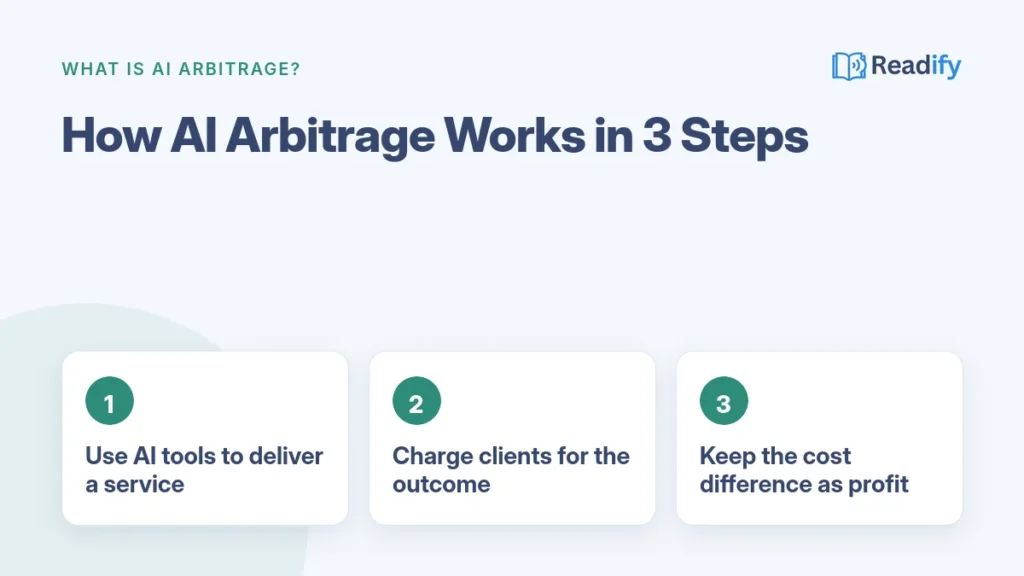
What is AI arbitrage? It is a business model where you use AI tools to deliver a service faster and cheaper than the price clients are willing to pay, and keep the difference as profit. It is one of the most talked-about ways to make money online today.
Have you ever wondered how some businesses seem to achieve remarkable outcomes while spending less? This intriguing phenomenon can be attributed to a strategy that leverages technology and human expertise. It’s known as a form of efficiency that can create significant advantages in the market.
In this guide, we will explore how advanced tools and methodologies enable companies to close the gap between client revenue and delivery costs. By focusing on measurable outcomes and practical systems, businesses can optimize their operations effectively.
We’ll also introduce two primary models that beginners encounter: retail and agency frameworks. These models illustrate how companies can enhance their speed and profit margins while navigating the complexities of modern markets.
With insights from industry leaders like Ascendion, which employs thousands of engineers and AI agents globally, you’ll discover how this strategy operates on a large scale. Ultimately, success hinges on human judgment and the right tools, making this an exciting area to explore.
What Is AI Arbitrage? A Quick Introduction
It’s fascinating to see how certain businesses thrive by minimizing expenses. This concept of efficiency is central to understanding the value of technology in modern operations. According to Karthik Krishnamurthy, CEO of Ascendion, this strategy serves as a significant value lever in the $1.4 trillion IT services industry.
For beginners, the essence of this approach lies in delivering equal or improved outcomes for clients while reducing time and labor. This doesn’t mean eliminating human roles but rather enhancing them. Here are key distinctions:
- Automation vs. AI Arbitrage: Automation removes repetitive tasks, while AI arbitrage reallocates saved resources to innovation.
- Outcome-Based Services: Agencies are shifting from hourly billing to selling results, using AI-assisted workflows.
- Common Services: Popular offerings include SEO content, lead generation, and customer support.
It’s crucial to note that AI tools can enhance delivery economics only when organizations maintain quality and oversight. Clear service definitions ensure that businesses can harness these tools effectively.
The Evolution from Labor Arbitrage to AI Arbitrage
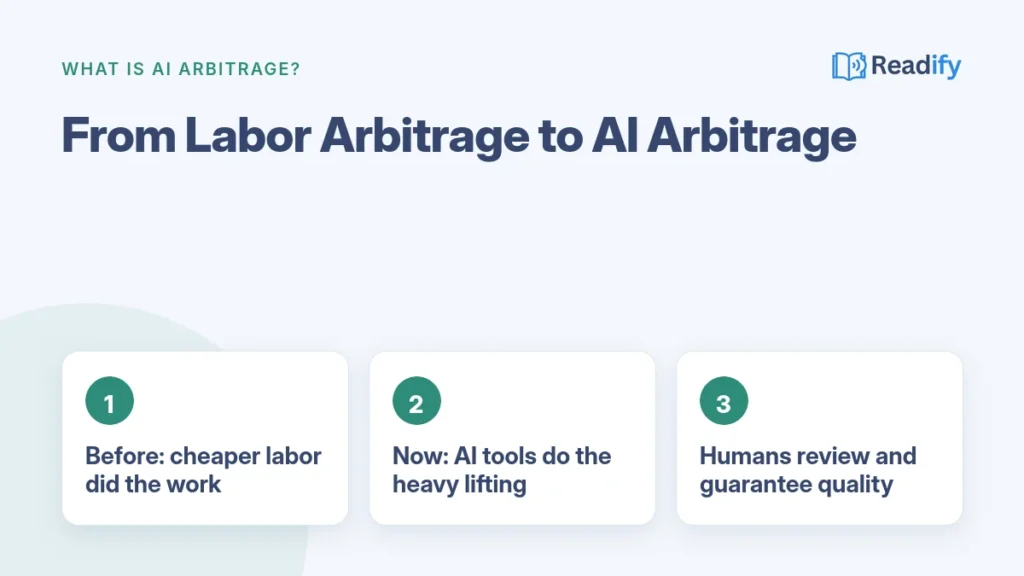
Over the past six decades, businesses have relied on a strategy that leverages lower-cost labor to drive efficiencies. Labor arbitrage has been the backbone of enterprise engineering economics, allowing companies to access talent in regions with wage disparities.
However, rising wages in these traditional delivery locations have gradually compressed the cost advantages. As a result, the focus is shifting from where work is performed to how it is executed.
AI efficiency plays a crucial role in this transition. AI agents can handle execution tasks, freeing engineers to focus on validation, architecture, and quality assurance. This shift allows for ongoing improvements in processes and workflows.
Unlike labor arbitrage, which often results in one-time savings, AI arbitrage can lead to compounding benefits as platforms evolve. This historical shift not only connects lower delivery costs with faster output but also enhances reinvestment capacity and scalability.
Fundamentals: What Is AI Arbitrage?
Many businesses find innovative ways to deliver high-quality results while controlling costs. Understanding the core concepts behind this approach is essential for maximizing efficiency. The fundamental formula for success in this realm is simple: client revenue minus AI-assisted delivery costs.
So, what is AI arbitrage in simple terms? It is the practice of delivering a service with AI tools at a much lower cost than the price the client is willing to pay, and keeping the difference as profit, while a human still checks the quality of the result.
AI agents excel in executing structured tasks such as code generation, test scenario creation, and documentation. These tasks occur within defined boundaries, ensuring that quality remains stable or improves. However, human oversight is crucial for validation and architectural guidance, especially when it comes to legal or reputational matters.
Productized services often utilize fixed deliverables, such as monthly retainers or performance bonuses. This structure makes the AI arbitrage strategy repeatable and scalable. Ultimately, this approach acts as an operating system for producing outcomes, reinforcing accountability at every stage.
How AI-Driven Tools Automate Services
Many organizations are leveraging advanced tools to uncover hidden opportunities in their service delivery. By analyzing data, they can spot price gaps and demand changes that may go unnoticed. This proactive approach enables businesses to identify delivery bottlenecks and streamline their operations.
For instance, financial services companies have successfully reduced incident detection and resolution times by 20-30% through effective technical debt remediation. This improvement showcases how automation can enhance operational efficiency.
AAVA, a leader in quality engineering, has achieved a remarkable 40% improvement in test-cycle time. This illustrates that automation can boost speed without compromising the quality of structured testing.
AI-supported services span various categories, including content production, advertising variations, lead enrichment, and support-ticket triage. However, it’s essential to remember that automation generates value only when combined with robust approval rules, factual checks, and measurable performance indicators.
Deep Dive into AI Arbitrage Models
The dynamics of market strategies reveal how businesses optimize their operations for better results. Two primary models illustrate this concept: retail and agency.
Retail AI Arbitrage: The Flipper Model
In retail, software can scan up to 50,000 online items to find price discrepancies. For example, a LEGO set priced at $40 on a clearance site can sell for $85 on Amazon. This model focuses on physical products, where demand and resale prices are crucial for profitability.
Agency AI Arbitrage: Leveraging Outcome-Based Services
On the agency side, businesses like dental-content agencies charge around $500 monthly for about 1.5 hours of AI-assisted work. This model emphasizes delivery costs and client outcomes. Additionally, crosslisting tools can reduce listing times from 15 minutes to just 1 minute across platforms like eBay and Poshmark.
Reliable fulfillment remains vital, especially with US-based inventory offering shipping times of 2-5 days. This ensures a positive customer experience, which is essential for both models.
Generating Business Value with AI Arbitrage
Innovative strategies are reshaping how companies approach profitability and efficiency. By leveraging advanced technologies, businesses can realize substantial gains in productivity. For instance, Ascendion engineers utilizing AAVA report impressive productivity gains of 57-65%.
Moreover, a digital-first banking pioneer successfully reduced modernization costs from $36 million to $9 million. This demonstrates how efficiency can create significant enterprise-level value. Additionally, a top-five global bank achieved $20 million in immediate customer-service savings, showcasing measurable operational results.
Furthermore, a Fortune 100 technology company is targeting $1 billion in savings over five years. This highlights the potential scale of reinvesting efficiency gains. Responsible businesses are redirecting these savings into innovation, technical-debt reduction, product development, and enhanced customer experiences.
Managing Risks and Challenges in AI Arbitrage
In today’s fast-paced market, awareness of challenges can protect businesses from costly mistakes. While AI strategies can enhance efficiency, they also come with potential pitfalls that must be navigated carefully.
Quality is the biggest risk. Google explains in its guidance on using generative AI content that AI-generated content is fine when it is helpful and original, but low-value content produced at scale can be treated as spam. Anyone asking what is AI arbitrage should remember this rule: the value comes from the human review, not from the volume.
For instance, a failed automated dropshipping venture involved a $500 upfront payment, leading to losses due to incorrect customer addresses. This example highlights the need for transparency and accountability in such systems.
Similarly, in the crypto world, buying Bitcoin on Coinbase for $90,000 and selling it on Kraken for $90,050 demonstrates the importance of managing thin spreads, requiring capital and speed.
Moreover, a 2025 grid bot that continued buying during a market crash depleted the operator’s funds. This shows the distinction between operational AI strategies and speculative trading.
Compliance is another critical aspect. AI-generated work may lack copyright protection in some areas without meaningful human authorship. Businesses must ensure quality control to maintain client trust.
- Verify systems to avoid opaque operations.
- Implement human oversight and approval workflows for AI outputs.
- Establish separate workspaces for AI-generated content to ensure quality checks.
Implementing AI in Your Business Workflow
Incorporating advanced technology into daily workflows can transform business operations. By utilizing AI agents, businesses can enhance their efficiency and effectiveness.
AI agents excel at defined execution tasks, allowing engineers to focus on validation and architectural guidance. This ensures that quality remains high while operational tasks are streamlined.
Integrating AI Agents into Daily Operations
AAVA orchestrates automation across various capabilities, including experience, platform, data, quality, and operations. This integration can connect daily processes seamlessly.
- Role-based approvals: These ensure that decisions are made with the right oversight.
- Audit trails: Keeping track of actions helps maintain accountability.
- Human-at-the-wheel checkpoints: These allow for critical decision-making by humans.
- Automatic crosslisting: This feature removes products from other marketplaces once sold, reducing double-selling risks.
- Start small: Begin with one repeatable workflow before expanding AI integration.
The Role of Human Oversight in AI Systems
While AI agents handle many tasks, human oversight remains crucial. Engineers and operators are responsible for quality assurance and decisions requiring contextual judgment.
Best Practices for Successful AI Arbitrage
Crafting effective workflows is essential for businesses aiming to harness the power of modern technology. A practical agency delivery sequence involves several key steps to ensure success.
First, beginners should choose one niche and define a painful outcome. This could be related to qualified calls, faster publishing, or quicker support resolution. Establishing a clear focus helps streamline efforts.
Next, intake systems must capture brand voice, compliance rules, and approved examples. Explicit do-not-say instructions should also be included before production begins. This preparation sets the stage for effective outcomes.
To evaluate delivery performance, consider metrics such as speed, quality signals, conversion rates, and time saved. These metrics provide a clearer picture than vague claims about capabilities.
For instance, the Closo demand-prediction example illustrates the importance of data. When predicted demand for smart water bottles fell by 40% in one month, it became clear that data should guide purchasing decisions.
Finally, implementing repeatable prompts, QA checklists, and approval checkpoints will make workflows easier to standardize across clients. This structured approach can lead to better efficiency and improved results.
Keep reading
- How to become a freelance writer, a service you can scale with AI
- Ahrefs vs SpyFu vs Semrush: the SEO tools behind many AI agencies
- How to improve brand visibility in AI search engines
Want to go further?
Download practical ebooks and audiobooks on productivity, online business and digital marketing in the Readify shop, or start with our free ebook.
Conclusion
Understanding how businesses maximize efficiency can be enlightening. This approach to delivering products or services is not a guaranteed-return scheme or a shortcut to passive income.
Now that you know what is AI arbitrage and how it works, start small: pick one service you understand, test it with a few clients, and keep a human in charge of the final quality.
Now that you know what is AI arbitrage and how it works, the best next step is to test one small, paid service and measure your margins before you scale.
Strong evidence, such as Ascendion’s 57-65% productivity gains and AAVA’s 40% improvement in quality-engineering cycles, showcases the effectiveness of this strategy.
For beginners in retail, studying price gaps like the $40 LEGO purchase and $85 Amazon resale can provide valuable insights. Agencies can focus on packaging outcomes, such as offering $500 monthly dental content.
Sustainable results rely on reliable tools, accurate data, controlled scope, and human oversight. Legal compliance and consistent quality assurance are also essential.
A practical starting point involves selecting one narrow workflow with measurable performance targets. Careful testing, documentation, and responsible expansion will lead to long-term success.


One Comment
Comments are closed.