
How to Sell a Product: A Simple Guide for Beginners
Wondering how to sell a product when you are just starting out? This guide walks you through every step, from finding a real need and setting a price to choosing a sales channel and making your first sale.
What should you focus on before trying to make your first sale? Start by deciding who needs your offer and what it helps them do. A clear customer need gives your business a useful direction, even when you are starting with limited time, money, or experience.
Your target audience is the group of people most likely to need and buy your offer. Understanding that audience helps you set practical goals, choose where to reach customers, and make your message relevant. You do not need a large catalog or a perfect plan to begin. Start small, pay attention to people’s responses, and improve as you learn.
Social media can help you find interested people, but a useful offer and a clear way to buy matter just as much. A first sale is a chance to learn what customers value and where they need more information. This guide offers a practical sequence, from choosing an offer with real demand to reaching buyers and supporting a purchase. Begin with a problem people already want solved.
Key Takeaways
- Start with a customer problem you understand.
- Test interest before committing to a large batch.
- Account for costs before setting a price.
- Choose a sales channel your customers already use.
- Use early questions and feedback to improve your offer.
What Should You Sell to Solve a Real Need?
A neighborhood gardener who hears repeated complaints about heavy planters could test lightweight containers with a small local batch. A useful offer solves a specific problem for people you can identify and reach. It can be something you make, source, or deliver as a service or digital item.
Start With a Problem You Understand
Begin with problems you have seen firsthand through work, hobbies, or community ties. Your experience may show what people struggle to find, use, or finish. An idea becomes stronger when you can name who faces the problem and what a better result would look like.
Ask a few potential customers how they handle the issue now. Listen for repeated workarounds, frustrations, or unmet needs instead of steering people toward your favorite idea. Then consider whether you can make or obtain a dependable solution without taking on more than you can manage.
Test Demand Before Building at Scale
A minimum viable product (MVP) is a small version of an offer used to test customer interest before a full-scale launch. A small first batch of scented candles sold through a simple landing page can test whether people respond to the product and its presentation.
Before making a larger commitment, check whether the test has:
- A clear need that customers recognize.
- Reachable buyers you can contact or serve.
- A manageable first batch you can afford to make or source.
- Useful feedback you can act on after the test.
What you can sell to make $1,000 depends on demand, costs, and your ability to reach buyers; no item or income is guaranteed. The easiest thing to sell and make money from is often an offer you can deliver reliably to people you can already reach. Use those early responses to judge whether enough customers want the offer.
How Do You Research Customers and Competitors?
Repeated complaints in reviews for a lunch bag might point to a product gap, such as hard-to-clean seams. Use customer behavior and market evidence to test demand instead of relying on guesses. Research cannot promise a sale, but it can show what buyers care about and what alternatives already address their needs.
For a structured approach to customer and competitor research, the U.S. Small Business Administration has a free guide to market research and competitive analysis.
Learn What Buyers Need
Have brief conversations with people who resemble likely customers. Ask what they use now, what frustrates them, and what would make them switch. Short surveys can help you spot common answers, while customer reviews reveal specific praise and complaints.
Pay attention to questions people ask in stores, online groups, or support forums. These questions can uncover missing information or buying concerns. Google Trends shows how interest in a search term changes over time. Think with Google, Statista, and IBISWorld also offer ways to explore customer behavior or market information.
Compare Alternatives and Look for Gaps
Direct competitors sell a similar offer. Indirect alternatives solve the same problem in a different way. Comparing both helps you see where your product might fit, what buyers expect, and whether an apparent gap matters to customers.
Choose research methods that fit the question you need answered:
| Research method | What it can reveal | How to use the finding |
|---|---|---|
| Customer conversations | Needs, routines, and buying motivations | Adjust the offer to address repeated concerns |
| Reviews | Common praise, complaints, and product issues | Check whether a gap matters to likely buyers |
| Search-interest tools | Changes in searches for a topic over time | Compare interest across terms or periods |
| Competitor listings | Features, prices, and buyer questions | Identify alternatives and explain your difference |
What sells very fast and what can be sold immediately vary with timing, location, price, and existing demand. Research can point to opportunities, but it cannot promise speed. Use the strongest customer insight to explain why your offer is worth choosing.
How to Sell a Product: Set a Price That Covers Costs
A handmade mug may look profitable at its listed price until you count its box, shipping, and payment fees. Your price needs to cover the cost of making or acquiring each item, selling it, and getting it to the buyer. That starting calculation helps you avoid mistaking revenue for profit.
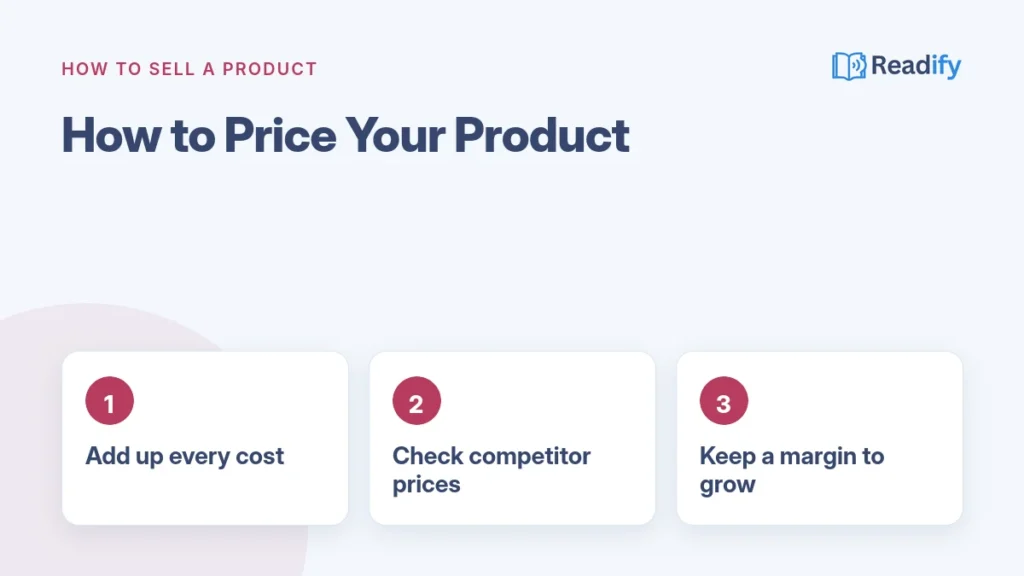
Start with a simple break-even check. Add per-item costs, then account for the selling channel’s fees and fulfillment. Set a price that leaves room for operating expenses and profit, rather than only covering the item itself.
| Cost category | What to count | How it affects the price |
|---|---|---|
| Product acquisition or production | COGS, including materials or wholesale cost | Sets the base cost per item |
| Packaging and shipping | Boxes, labels, postage, and handling | Adds the cost of preparing delivery |
| Selling and payment fees | Platform fees and payment processing | Reduces the amount kept from each sale |
| Promotion or overhead | Marketing and operating expenses | Requires room beyond per-item costs |
A price depends on costs, customer expectations, competition, and perceived value, not one formula. To flip $1,000 into $10,000, there is no dependable, guaranteed method. Buying and reselling also risks unsold inventory and added costs. Once the numbers make sense, choose a place to sell.
Which Sales Channel Fits Your Product?
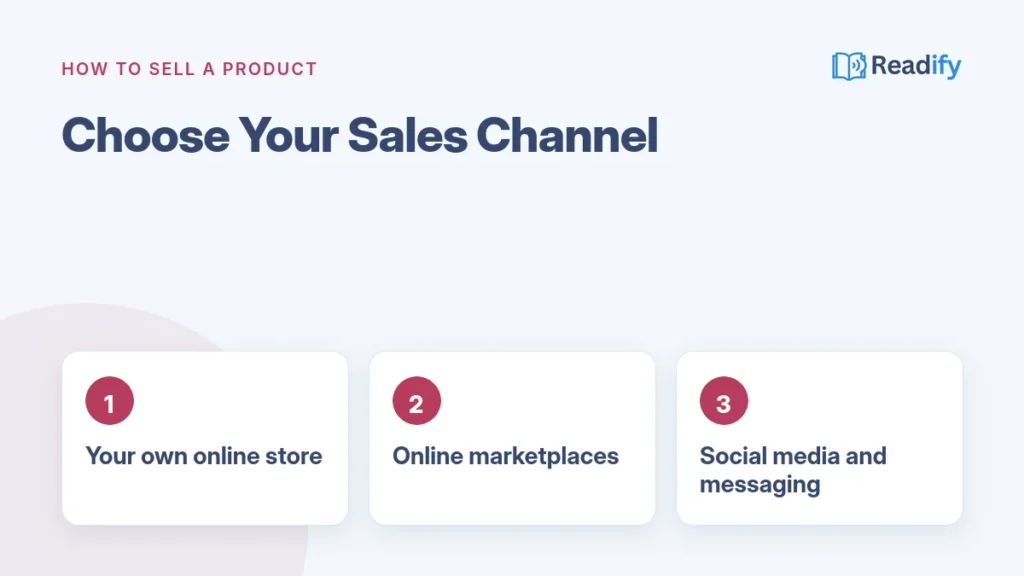
A handmade candle may get discovered through a visual marketplace, while a custom-built desk may need a detailed brand website. Choose a sales channel based on how customers shop and what you can manage consistently. You can begin with one place, learn how it performs, and add another when the work is manageable.
Not sure which channel to pick? Our step-by-step guides show you the exact platform we recommend, and why:
- Selling ebooks, templates or other files? Launch Your Digital Products Business reveals the best platform to sell your files, with a real profit example and a launch checklist.
- Want to sell T-shirts, mugs or merch without stock? Launch Your Print-on-Demand Brand shows the best platform for beginners and how to price every product.
Sell Through Your Own Website or a Marketplace
An independent website gives you more control over the design, product information, and customer experience. You also need to bring shoppers to it and manage the site. Online marketplaces already attract shoppers, but they set platform rules and charge fees that affect how you sell.
Popular online marketplaces each attract different shoppers: some are known for handmade and creative goods, others for collectibles or everyday products. Compare the shoppers and rules on each platform with the level of control your product needs.
Use Social Commerce or In-Person Selling
Social commerce lets people discover products through social media content and, on some platforms, shop there too. It can suit an offer that is easy to show in a short video or demonstration. Local markets and pop-ups let buyers see or handle an item and ask questions face to face.
Choose in-person events based on whether the likely customers attend and whether you can manage setup and sales. A local market may help you learn from direct conversations. It also takes time to prepare and staff a booth, so plan around your capacity.
Consider Business-to-Business Sales
Selling to a retailer or another business differs from selling directly to individuals. A business buyer may need product details, reliable supply, and terms that fit its own operations. You may have to contact decision-makers and explain how the offer fits their customers or work.
For service businesses, tailored outreach, relevant samples, networking, and direct contact can help you find clients. Read these tips for starting a freelance writing business for an example of presenting work to potential clients.
| Channel | Where customers discover the offer | Seller control | Suitable use |
|---|---|---|---|
| Own website | Search, referrals, and promotion | More control over the brand and page | Custom products needing detailed information |
| Online marketplace | Marketplace searches and browsing | Bound by platform rules and fees | Products shoppers already search for |
| Social commerce | Social media posts and demonstrations | Bound by platform tools and rules | Offers that are easy to show visually |
| In-person or B2B | Local events or business outreach | Direct interaction, with event or buyer terms | Items people can inspect or business supplies |
The easiest product to flip depends on finding a buyer, understanding condition and demand, and counting transaction and delivery costs. No fast seller is guaranteed. Wherever you list or present an offer, make its value clear.
How Do You Explain Why Your Product Is Worth Buying?
A commuter may choose a small flashlight because it fits in a jacket pocket, not because it has the longest feature list. Explain how a product feature helps a customer with a specific need. A feature-benefit matrix makes that connection easy to check before you write a description or speak with a buyer.
For example, waterproof construction can help keep an item dry. Wireless charging can remove the need for a charging cable. Describe only benefits that are accurate and verifiable; an inflated claim can leave a customer disappointed and weaken trust.
To answer “sell me this product,” start by asking what the person needs. Then connect one relevant feature to that need: “Do you need a light for evening walks? This compact flashlight fits in a jacket pocket, so it is easy to carry. Would you like to see how it works?” A strong answer begins with a question, not a memorized pitch. Once your value proposition is clear, you can focus on reaching potential customers.
How Can You Reach Potential Customers?
A maker can post a short demonstration of a reusable food wrap where prospective customers already browse for kitchen ideas. Focus your marketing on places your audience uses instead of trying every channel at once. The right mix depends on how customers find ideas and how much time you can give each tactic.
Choose Marketing Tactics That Fit the Audience
Social media posts can show how a product works or answer common questions. A demonstration suits an item whose value is easier to see than explain. Partnerships can help when another business or creator already serves your audience. Paid promotion may reach more people, but it can spend money before your message or audience is proven, so start with a bounded test.
Choose a schedule you can keep. A few useful posts each week may be more realistic than daily content, especially if you make each item yourself. If you sell a service, relevant samples and tailored outreach can help you contact businesses. Find more ideas in these freelance writing business tips.
Build Repeatable Ways to Stay in Touch
Use email follow-up only with people who have agreed to receive it. A simple content schedule can keep your message consistent without taking over your week. Include one clear call to action, such as visiting the product page or replying with a question.
Four launch activities can keep your first outreach useful:
- Demonstrate the product in use.
- Answer a common customer question.
- Share a customer-use scenario.
- Direct interested people to the purchase page.
Use the same clear next step across your marketing, whether someone finds you through email or social media. Watch which posts bring questions or visits, and adjust your effort accordingly. After attracting interest, shift your attention to understanding and responding to a buyer’s needs.
What Should You Say in a Sales Conversation?
A seller with a prepared pitch can pause to ask what a customer wants to solve before describing the product. A respectful sales conversation starts with the buyer’s needs, then offers a clear next step without pressure. Listening first helps you avoid listing features that do not matter to that person.
Ask Questions and Listen Before Pitching
Use open questions that invite a real answer: “What are you trying to make easier?” “What do you use now?” “What concerns you about switching?” Give the buyer time to answer. Listen without interrupting, and ask a follow-up only when you need to understand more.
The customer’s answer can show which part of your offer deserves attention. It can also reveal that your product is not a good fit. Being willing to say so builds more trust than forcing a pitch into every conversation.
Match Benefits to the Buyer’s Need
Connect only relevant features to the buyer’s stated priorities. If a shopper wants a lunch container that is easy to clean, explain how its removable parts help with cleaning, if that is true. Skip unrelated features, and avoid promising an outcome your product cannot guarantee.
Keep the explanation simple enough for the person to compare your offer with their current solution. If they ask about a feature, answer directly. A useful reply gives information the buyer can act on, rather than adding a sales claim they did not ask for.
Respond to Concerns and Invite a Decision
Take an objection seriously. Clarify whether the concern is about fit, timing, price, or another issue, then answer honestly. If you do not know, say so and find out before making a claim. Explain the next step, including how the buyer can place an order.
Invite a decision without pushing for one. You might ask, “Would you like to order it, or would you rather think it over?” The 3-3-3 rule has no single universal definition in sales, so explain a particular version only when everyone using it understands its meaning.
Useful sales practices include:
- Understand the need before recommending an offer.
- Listen carefully without interrupting.
- Explain value that relates to the buyer’s priorities.
- Answer concerns truthfully, including what you do not know.
- Make the next step clear and leave room for a decision.
There is no single official set of seven golden rules of sales. These five principles are useful practices, not a universal standard. Making a sale also means setting clear expectations for delivery and support.
How Do You Make Your First Sale From Home?
A seller working from home can test a small batch with an online listing before buying more stock. Before you take an order, confirm that you can provide the offer, accept payment, and answer customer questions. A short, manageable test can help you learn without taking on more work than you can handle.
Prepare a small amount of sellable inventory or a digital offer. Create a clear place to buy, tell likely customers where to find it, answer questions, and confirm each order. These steps give you a simple process to manage alongside your other responsibilities.
Selling products online from home still takes time, accurate availability, a clear way to take payment, and a plan for customer questions. Do not accept orders for stock or delivery dates you cannot confirm. Keep the first test within the tools and capacity you already have, then improve the product page as buyers ask questions.
How Do You Make an Online Listing Easy to Buy From?
A buyer may leave a listing when a key detail, such as size or delivery information, is missing. A useful online listing answers basic questions and makes the purchase step easy to find. Clear information helps customers decide whether the offer fits before they reach checkout.
Write a Clear Product Page
Use a clear title and accurate description. Explain how the product is used and what benefit it offers, rather than repeating a list of features. Include useful photos, dimensions or materials when relevant, current availability, and the price.
Put the checkout where buyers can find it without searching. Add a clear contact option for people who need more information. A simple page can still answer the main questions: what the product is, who it suits, what it costs, and how to order.
Use this five-point listing checklist:
- Accurate title that names the product.
- Benefit-led description that explains its use.
- Clear photos that show relevant details.
- Current price and availability.
- Visible purchase and contact options.
Selling Products Online From Home
When selling products online from home, track inventory, reply to customers, handle payments, and arrange fulfillment. A useful product page should match what you can actually provide. Update the listing when availability changes so buyers do not order something you cannot supply.
To learn how to sell a product online, link a useful product page to a simple checkout and suitable promotion. A marketplace’s rules and fees differ from those of an independent website, so make the buying steps clear on whichever one you use. Once checkout is complete, focus on getting the order to the customer.
How Do You Fulfill Orders and Support Customers?
After a customer pays for a notebook, confirm the order, send it by the stated delivery estimate, and provide a contact route if anything goes wrong. Prompt confirmation, clear delivery expectations, and accessible support help customers know what happens next. Keep the same care if you use a supplier to fulfill orders.
If you ship orders yourself, prepare and send each product according to your stated timing. Dropshipping is a fulfillment method in which you do not keep the product in stock; a third-party supplier ships the order to the customer.
Dropshipping does not remove your responsibility for the customer’s experience. If an order is delayed or arrives with a problem, respond and explain what you can do. Make the contact route easy to find and send an order confirmation promptly. For digital products, state the support and refund terms clearly, as in this refund and returns policy. Use customer responses to improve your next sales attempt.
How Can You Learn From Your First Sales?
If several interested buyers ask whether a storage bin fits under a bed, the listing may need clearer dimensions. Track a few useful signals and use repeated patterns to decide what to improve next. Early sales and questions can show where customers need more information or a different offer.
Note the questions people ask before buying, which channel brought a buyer, where checkout stalls, and what customers say afterward. Watch for repeat interest, too. These small pieces of data can help you understand what is working without building a complicated tracking system.
Look for a pattern before changing your product explanation, sales channel, or offer. If buyers repeatedly misunderstand one detail, revise that explanation first. One sale or one person’s feedback is not proof that a product will always sell. Choose one focused improvement and try it in your next round of outreach.
Ready to Make Your First Sale? Get the Step-by-Step Guide
This article gives you the map. Our ebooks give you the exact route, in about 10 pages each, with no fluff.
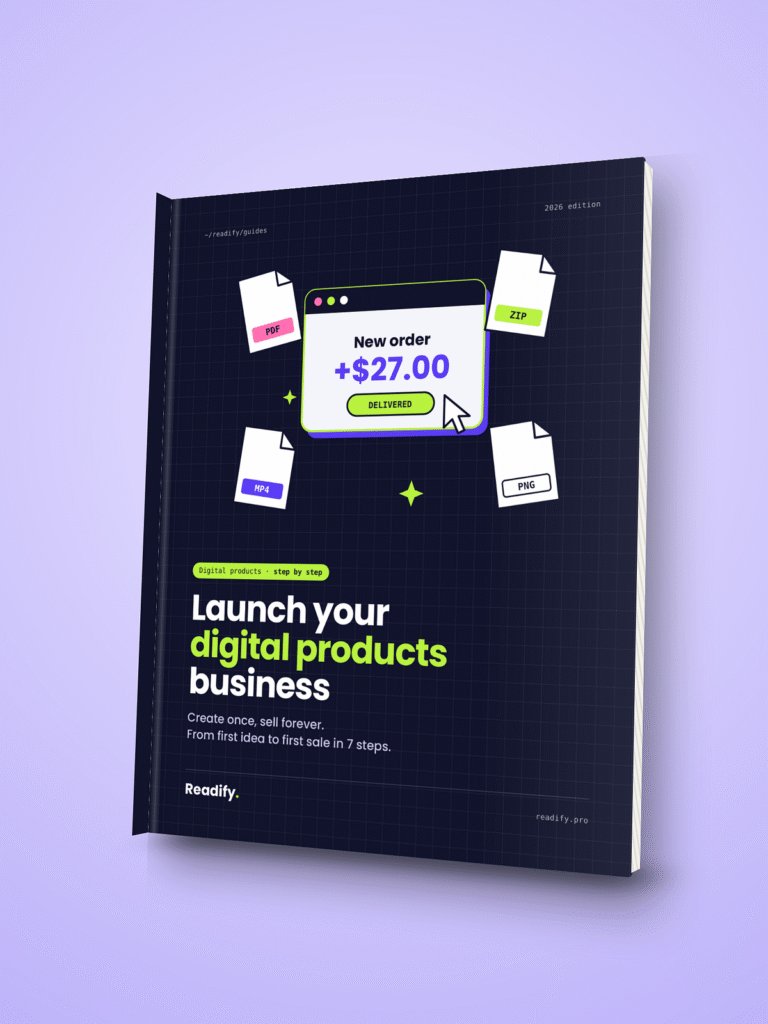
Launch Your Digital Products Business
For ebooks, templates, printables and other files.
- The platform to sell your files, and why
- When upgrading your plan saves you money
- A real profit example on a $19 ebook
- A ready-to-use launch checklist
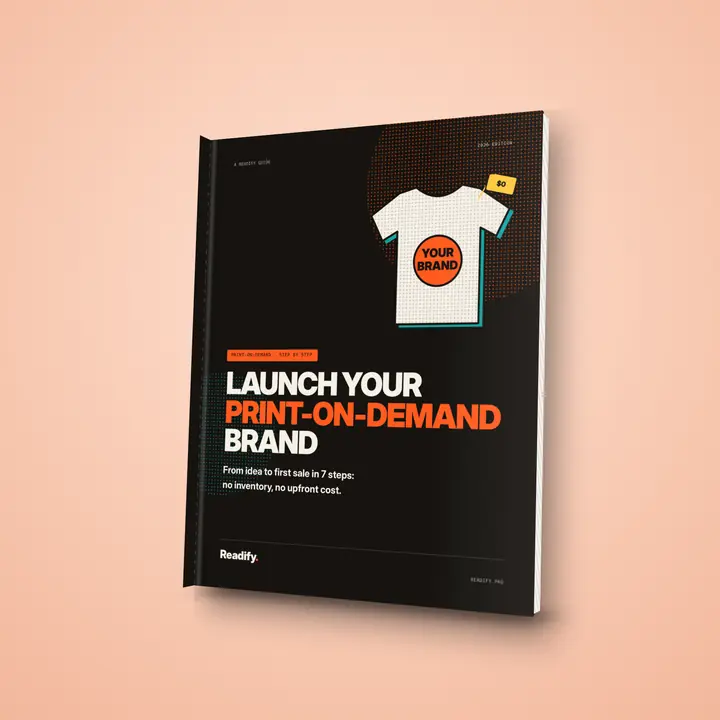
Launch Your Print-on-Demand Brand
For T-shirts, mugs and merch with no stock.
- The best platform for beginners
- A profit formula to price every product
- How to connect your own domain
- A ready-to-use launch checklist
PDF · instant download · beginner-friendly.
Keep reading
Free ebooks from Readify
Download these free PDF guides:
Want to go deeper? Discover our premium ebooks and audiobooks, or browse all free ebooks.
Conclusion
Beginners can make progress by starting small and learning from real customer responses. Keep your offer relevant to a real need, and make it easy to understand and buy. Those two choices give your business a practical foundation without requiring a large launch or a perfect plan.
A clear customer problem is a better starting point than a guess about what might sell. You can test an offer, listen to the people who respond, and improve one part at a time. Your immediate next step is simple: write down one customer problem and ask a potential buyer what they currently do about it.
FAQ
What is the first step in learning how to sell a product?
Start with the customer: identify a real need and the people most likely to pay to solve it, before you think about price or platform.
How do I price my product?
Add up every cost, check what similar products sell for, and keep a margin that lets your business grow.
Where should I sell my product online?
Choose the channel where your customers already shop: your own online store, a marketplace or social media. For digital products and print on demand, our guides Launch Your Digital Products Business and Launch Your Print-on-Demand Brand show the platforms we recommend.
How can I make my first sale faster?
Focus on one channel, explain your product clearly, and start by reaching people who already know and trust you.
One Comment
Comments are closed.