
Video Ads for Small Business: How to Plan, Make and Measure One
Do you want a video ad to grow your small business, but don’t know where to start? A short, clear video can explain your product faster than text and give people a reason to click, visit or buy. And you don’t need a big agency budget to make one.
This guide to video ads for small business shows you what a good ad should do, which style fits your brand, where to run it, what it costs and how to know if it works, whether you film it yourself with a phone or hire a freelancer or a production company. For more growth ideas, see our digital marketing guides.
The right approach starts with your goal, your target audience, and where the campaign will appear. A spot made for a website may need a different opening or shape than one built for a paid placement. The creative should fit the setting and feel true to your brand.
A strong video can support marketing, but it cannot guarantee sales or viral reach. Results also depend on the offer, the audience, the distribution plan, and what happens after someone watches. You can still make useful choices before production begins.
Key Takeaways
- Give the commercial ad one clear message and one intended next step.
- Choose a style that fits the brand voice and campaign goal.
- Plan placement and versions before creative work is locked.
- Set budget, schedule, and approval needs early.
- Judge results against the campaign’s own objective.
Here’s a practical look at what a video ad should do, how it gets made, and what to decide before you start.
What Is a Video Advert, and What Should It Do?
A video advert is a short promotional video made to attract attention and encourage action. A commercial ad works best when it gives viewers one clear message and a reason to respond. It can introduce a brand, product, or service without asking people to absorb every detail at once.
Advertising often uses this format near the top of funnel, the awareness stage, where a campaign first introduces a brand, product, or service to potential customers. At this stage, many viewers do not know the company or its offer. The ad aims to make the introduction clear enough to earn interest.
An explainer video usually gives more detail about how something works. A commercial video can create a first impression, set a tone, and direct people to learn more. The product may appear, but the spot does not need to cover every feature, use case, or condition.
Depending on the marketing goal, a video advert may aim to:
- Build brand awareness.
- Introduce a product or service.
- Create interest or excitement.
- Prompt a specific next action.
Those aims call for different creative choices. A new service might need a simple, relatable scenario, while a familiar brand may focus on a new offer. Either way, a short ad should not try to explain everything. A single main message helps the audience understand what matters before the spot ends.
That message also shapes the script, visuals, and call to action. A viewer might be asked to visit a website, explore a product, or sign up. The next step should match the campaign, not feel added on at the last minute. With that purpose in place, the practical work of making the ad becomes easier to define.
How Is a Video Ad Made, Step by Step?
Whether you make it yourself or hire help, a video ad goes through the same three phases: pre-production (planning), production (filming or animation) and post-production (editing). Each phase depends on decisions made earlier.
Planning the concept, script, and visuals
Pre-production starts with a brief: the goal, target audience, main message, and intended use. The team develops concept options, then shapes the selected idea into a script and treatment. A treatment describes the look and feel, while storyboards show the planned scenes or frames.
For animated video content, an animatic can help show how images and sound may unfold over time. These planning tools make it easier to spot a confusing message or an impractical scene before filming. Agreeing on the concept before filming or animation helps avoid expensive changes later.
Filming and directing the spot
During production, the team coordinates crew, locations, lighting, sound, and talent to capture the planned footage. A director helps keep the performances and visual choices tied to the central idea. Practical details matter: a busy location may need a quieter time slot, while a product demonstration needs clear sightlines.
The plan should leave room for useful coverage, not just the shots described in the script. Extra angles or close-ups can give the editor options if a scene runs long or a transition feels abrupt. The client can help by making product experts or decision-makers available when needed.
Editing, sound, and final versions
Post-production turns the footage or animation into a finished spot. Editors shape the story, add music and sound design, record voiceover where needed, and build animation or effects. The team then shares a review version, gathers feedback, and prepares the approved final files.
Timely, consolidated feedback keeps revisions focused. If marketing, legal, and product teams each respond at different times, a small change can reopen decisions already settled. Align internal stakeholders on who approves the script, edits, and final delivery. Once the creative direction is clear, the next choice is which visual approach fits it.
Which Video Ad Style Fits Your Small Business?
A skincare brand can film a customer using a product or animate how an ingredient works beneath the surface. Choose a style that makes the message easier to understand and feels natural for your brand. The best fit depends on the story, not on which approach looks most elaborate.
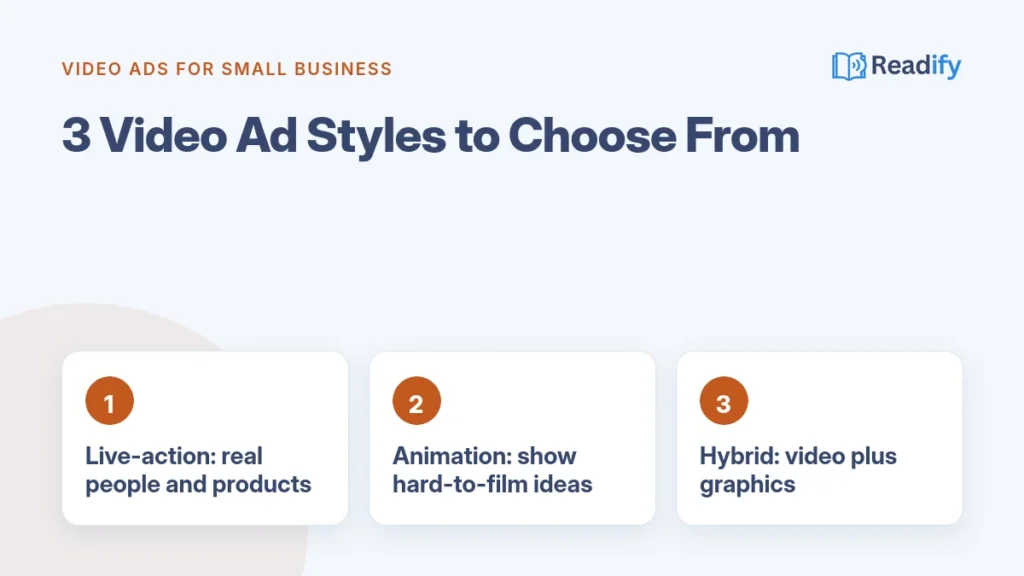
Live-action, animation, and hybrid commercial videos offer different ways to tell that story. An explainer or corporate video may use any of them, depending on the subject and tone. This comparison can help narrow the creative direction:
| Approach | Storytelling strength | Useful when | Planning tradeoff |
|---|---|---|---|
| Live-action | Shows people, places, or real product use | A real customer experience builds trust | Needs locations, cast, and coordinated filming |
| Animation | Visualizes features, processes, or abstract ideas | A process is hard to film clearly | Illustration and motion need careful design |
| Hybrid | Combines filmed material and animation | Real scenes need added visual explanation | Filmed and animated elements must match |
Live-action can make a service feel grounded, especially when people, places, or hands-on product use are central to the message. It may be less practical if the idea depends on showing something invisible, tiny, or difficult to film. Animation can make those details easier to see.
A hybrid approach can pair a real person with animated labels or diagrams. That can help viewers connect with a story while also seeing a feature or process. The added layers need a shared visual style, so the filmed scenes and animation feel like one piece.
Make the choice based on brand voice, message, budget, scope, and where the video will run. A playful brand may use movement and color, while a technical product may need a calm, clear demonstration. The intended placement also affects how the finished video is shaped.
Have a product to promote? A video ad works best when you already have something people can buy. Our step-by-step guides help you build it first:
- Launch Your Digital Products Business: create and sell ebooks, templates and other files.
- Launch Your Print-on-Demand Brand: sell T-shirts, mugs and merch with no stock, perfect for short video ads.
Can You Make a Video Ad Yourself?
Yes. Many small businesses make their first video ads with nothing more than a smartphone, natural light and a free editing app. A simple, honest video often performs well on social media, because it looks like the content people already watch.
- Film with your phone: shoot vertically for TikTok, Reels and Shorts, close to a window for soft light.
- Keep the sound clean: a small clip-on microphone makes a big difference.
- Edit with free tools: apps like CapCut or the Canva video editor let you cut clips, add captions and music.
- Add captions: many people watch videos without sound.
- Hook viewers in the first seconds: show the product or the problem right away.
Hire help when your idea needs actors, several locations, animation or a TV-quality finish.
Where Should Your Video Ad Run?
A pre-roll ad needs to make its point before a viewer skips, while a website video can begin after someone chooses to watch. Placement affects the opening, format, runtime, and versions a video campaign needs. Plan those details before the creative is locked.
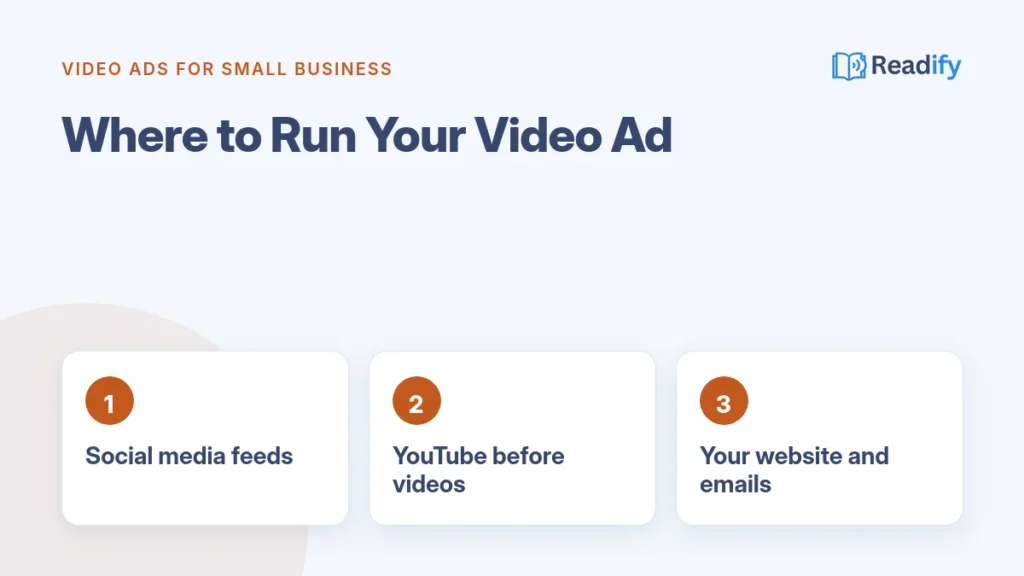
To run your video on YouTube, start with YouTube Ads, which lets you set a small daily budget and target viewers by interest and location.
Commercial ads commonly use strict runtimes such as 6, 15, or 30 seconds; 30 seconds is a common target, while longer versions may suit non-paid placements. The right cut depends on the viewing context and the job the spot needs to do.
| Placement | Viewing context | Creative consideration | Likely role |
|---|---|---|---|
| YouTube pre-roll | Viewer is waiting for selected content | Make the opening clear before a skip | Paid awareness or offer promotion |
| Paid social media | Viewer scrolls through a feed | Use a strong visual and readable text | Targeted reach or response |
| Connected TV or streaming | Viewer watches on a television screen | Design for a larger screen and sound | Broad campaign reach |
| Website or email | Viewer has chosen to visit or open | Connect the spot to nearby page content | Explain an offer or support a visit |
Platform and placement choices can affect runtime, aspect ratio, opening seconds, versions, and usage budget. A vertical social cut may need different framing from a widescreen version. Text that reads on a phone can look small on a television, so each version needs a review in its intended setting.
Teams may create several cuts or targeted versions from one creative concept. Paid promotion can help a spot reach its intended audience, but it cannot make viral success predictable. Decide which platforms and media placements matter before production, so the plan accounts for each required file.
Those choices shape the scope of the job. The number of versions, the shoot or animation needs, and the planned usage all affect the budget and schedule decisions that come next.
How Much Does a Video Ad Cost, and How Long Does It Take?
Video ad budgets vary widely with scope. A simple DIY video filmed on a phone can cost little more than your time, a freelancer usually charges far less than an agency, and a fully produced agency commercial can reach tens of thousands of dollars and take several weeks. Start with the smallest version that can test your message.
What affects the production budget?
Video production cost depends on style and complexity, video length, number of versions, intended usage, locations, talent, and music or other licensing. A straightforward one-location shoot has different needs from a project with several locations, a large cast, or detailed animation.
Five common cost factors are:
- Creative complexity.
- Filming locations and shoot days.
- Animation or effects.
- Talent and music licensing.
- Usage and versioning.
Usage matters because a video may need different rights for different placements or periods. Music and talent agreements also shape how the finished spot can be used. Producing a series may reduce the cost per video when creative planning or filming can be shared across the set.
Corporate video costs also vary by scope and intended use, so a commercial-video budget should not be treated as a fixed price for every corporate video. Rates reflect the actual work and rights needed, not simply the length of the finished file.
How much time should you plan?
Approvals, filming needs, and post-production complexity affect the schedule. A simple shoot with a small group of reviewers may move faster than a concept that needs several locations, animation, or rounds of internal review. A delayed approval can hold up work that is otherwise ready to proceed.
Before kickoff, agree on a review timeline with stakeholders. Decide who will combine comments, how much time each review gets, and who can approve changes. That keeps the team from waiting on scattered feedback or receiving conflicting direction late in the project.
Give the production team a clear view of immovable dates, such as a product launch or planned media buy. If the date is firm, it can shape the scope and review plan from the start. Once resources and timing are understood, the next question is how to judge the finished ad.
How Can You Measure Your Video Ad’s Success?
Success starts with reaching the intended viewers, then depends on what they do with the message. Choose measures that match the campaign objective before launch, rather than judging every video by the same number. Views and responses mean little without that context.
Start with reach and views
Views are a leading indicator because an ad cannot do its job if the audience does not see it. Interpret view counts alongside the campaign’s intended reach and paid distribution. A modest count may fit a tightly targeted campaign, while a broad launch may call for more exposure.
Set a clear definition of a view for the platform and campaign you use. Then compare the number with the planned audience, the distribution level, and the length of the reporting period. A raw total alone cannot tell you whether the video reached the people the brand wanted.
Check attention and action
After reach, look at watch time and engagement to see whether viewers stayed with the content. Compare these numbers with your own previous videos rather than a universal benchmark, because results vary with audience, creative and placement.
Connect the call to action with a relevant downstream measure. If the ad invites viewers to visit a page, look at visits; if it asks for a response, track responses. The measure should reflect the next action the video was designed to prompt.
Choose success measures before launch so the team knows what to watch and why. Compare performance with the campaign’s own objective, not a broad claim about what every video should achieve. That makes the results useful for decisions about the message, distribution, and future work.
Measurement also depends on clear planning and follow-through. If you hire help, make sure they understand how the campaign will be judged and which video files you need for each platform.
Should You Hire a Freelancer or a Video Production Company?
If you decide not to film it yourself, you can hire a freelance videographer or a video production company. A freelancer is often the most affordable option for a simple ad, while a production company can coordinate a bigger project with crew, actors and animation. Either way, compare providers on relevant work and on how they will handle your project, not on a polished reel alone.
A video production agency is a team that develops and makes video content. A full service production company may coordinate creative, filming or animation, editing, and delivery. These services can sit under one roof or be managed across a wider production hub and partner network.
Check creative and production fit
Review examples that match your format, scope, or subject. Look for clear storytelling, a visual fit with your brand, and evidence that the company can solve the kind of creative problem you have. Ask what role the provider played in each example, especially when the work includes a large crew.
Commercial video production companies may describe themselves as experts across every format. Focus on work that resembles your need, such as a product spot, a short social cut, or a complex animated video. A team that can explain its creative choices is easier to assess than one relying on broad claims.
Confirm communication and campaign readiness
Ask who will lead communication, how feedback and approvals work, and how the team manages versions. A shared production hub, whether a workspace or a clear workflow, can keep schedules, approvals, and creative files together. That is especially useful when several stakeholders need access.
Check whether the team understands the campaign’s audience, intended placements, and measures of success. The provider should be able to discuss your vision in practical terms, including what is fixed and where the creative can shift. Clear answers at this point reduce confusion later.
AI can assist with some production tasks, but it does not remove the need for human judgment. Directing people, solving on-set problems, and collaborating with clients remain important roles. Tools will keep changing, so ask how the team uses them and where human review remains part of its process.
Once you know who will make the video, yourself included, a concise brief keeps the work focused.
What Should You Prepare Before You Film or Hire Someone?
Before you pick up your phone or contact a freelancer, write a short brief that names the audience, the message and the action you want viewers to take. It does not need to solve every creative detail, but it keeps your video focused.
Start with the information you already know. A few direct notes can help a provider understand the goal, shape the video content, and identify questions that need answers before the project moves ahead.
Include these five items:
- The campaign goal and target audience.
- The main message and any supporting proof.
- The desired viewer action.
- Likely placements and needed versions.
- Budget parameters, desired timing, and stakeholder approval needs.
Supporting proof might include a product feature, customer insight, or clear reason to believe the claim. Keep it relevant to the main message. If every benefit appears equally important, the creative team may struggle to decide what viewers should remember.
Note what is fixed and what can change. You might have an approved script, a required cast member, or a location already booked. Other parts, such as the script, cast, location, animation, or number of edits, may still be open to discussion.
That distinction helps the person you hire suggest options without changing something your brand has already approved. It also makes it easier to compare proposals: one provider may recommend a leaner concept, while another may suggest a broader scope. The brief should make the limits clear.
Identify internal decision-makers early and collect feedback through one clear approval path. If marketing, legal, product, and leadership all weigh in, decide who gathers their comments and who has final approval. A single, aligned response is more useful than several separate sets of notes.
There is one important exception: if the message, audience, or call to action is still unsettled, clarify those before locking a concept or scheduling a shoot. Otherwise, the team could spend time developing creative around a goal that later changes.
You do not need a polished presentation to start. Write down the goal, audience, placement and action you want viewers to take, then film a first simple version or share the brief with the person you hire.
Keep reading
Free ebooks from Readify
Download these free PDF guides:
Want to go deeper? Discover our premium ebooks and audiobooks, or browse all free ebooks.
Conclusion
Video ads for small business don’t need a big budget to work. A useful ad starts with one audience, one clear message and a defined next action. It should support your marketing goal without being asked to promise results it cannot control.
No product yet? Start with Launch Your Print-on-Demand Brand or Launch Your Digital Products Business, then make your first video ad to promote it.
Write a short brief, start with one simple video, measure what happens and improve the next one. That is how most small businesses build video ads that actually work.
FAQ
How much do video ads for small business cost?
It varies widely: a DIY video filmed on a phone can cost little more than your time, a freelancer costs more, and a fully produced agency commercial can reach tens of thousands of dollars.
How long should a video ad be?
Short versions of 6, 15 or 30 seconds are common for paid placements. Longer versions can work on your website or in emails.
Can I make a video ad with my phone?
Yes. A recent smartphone, natural light, a small microphone and a free editing app are enough for most social media ads.
Where should I post video ads for small business?
Where your customers already spend time: social media feeds, YouTube, your website or your emails.