
Ahrefs vs SpyFu vs Semrush (2026): Features & Pricing Compared
Ahrefs vs SpyFu vs Semrush: which SEO tool gives you the best value? In this comparison we review features, pricing, keyword data and competitor analysis side by side. You can find more reviews like this one in our AI & tools section.
Are you struggling to choose the right SEO tool for your needs? With so many options available, it can be overwhelming to decide which platform will truly elevate your marketing strategy. This article delves into the key features and pricing of three leading SEO tools: Ahrefs, SpyFu, and Semrush.
Each of these platforms offers unique strengths, catering to different marketing workflows and budgets. For instance, Ahrefs starts at just $29 per month, while SpyFu and Semrush begin at $33 and $117.33 per month, respectively. But how do these price points translate into value for your business?
In this comparison, we will explore essential features such as keyword research, competitor analysis, and content optimization. Our insights, based on over a decade of experience using these tools, will help you determine which platform aligns best with your goals. Join us as we uncover the nuances of each tool and help you make an informed decision.
Introduction to the SEO Tool Showdown
Navigating the world of SEO tools can be daunting for marketers. Each platform offers unique features and capabilities that cater to various business needs. Ahrefs, SpyFu, and Semrush are three of the most popular SEO tools available today.
In this Ahrefs vs SpyFu vs Semrush comparison, we look at the features, data and pricing of each platform. You can check the latest plans directly on the official websites of Ahrefs, SpyFu and Semrush, since prices and limits change often.
Understanding how these tools compare is essential for any digital marketing strategy. By evaluating their strengths, marketers can make informed decisions that lead to improved traffic and search rankings.
- Ahrefs supports Google rank tracking in 190 countries.
- SpyFu offers rank tracking for Google and Bing in 23 countries.
- Semrush covers Google, Bing, Baidu, and ChatGPT tracking in 117 countries.
Comparing these platforms involves looking at database coverage, reporting limits, and pricing. It’s important to consider how these factors impact marketing outcomes, such as content efficiency and competitor analysis.
Deep Dive into Ahrefs
The abundance of SEO tools can make it difficult to pinpoint the best fit for your strategy. Ahrefs stands out with its comprehensive features that cater to various aspects of SEO. Here’s a closer look at what makes Ahrefs a preferred choice for many marketers.
Key Features and Capabilities
- Keywords Explorer: Evaluates SERPs, search volume, keyword difficulty, and competitor rankings.
- Brand Radar: Monitors brand mentions across Google, AI Overviews, ChatGPT, and Perplexity.
- Site Audit: Crawls webpages to identify technical and content issues, providing prioritized recommendations.
- Internal-Link Suggestions: Offers recommendations for anchor text to improve site architecture.
Pros, Cons, and Use Cases
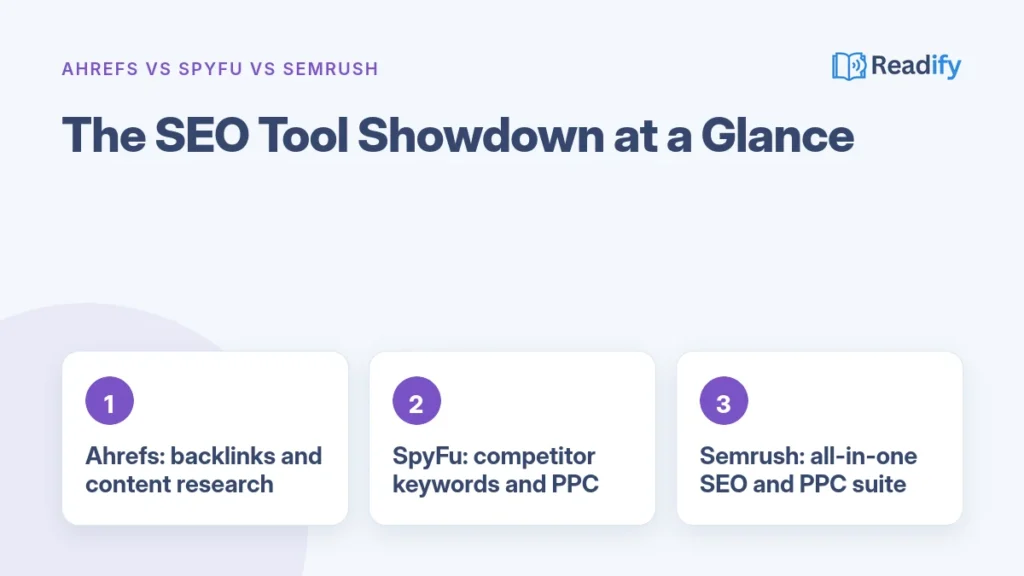
Ahrefs boasts a massive 28.7 billion keyword database and a free Webmaster Tools plan, making it accessible for beginners. However, its credit-based crawling system may limit some users. The tool excels in backlink analysis and link building, making it ideal for businesses focused on enhancing their online presence.
A Closer Look at SpyFu
Choosing the right SEO tool can feel overwhelming, especially with so many options available. SpyFu stands out by offering unique features that cater to competitive intelligence and historical data analysis.
This platform includes tools like Domain Overview, Keyword Overview, and PPC Kombat. These features are designed to enhance your competitive and paid-search workflows.
- Historical Data: SpyFu provides around 15 years of advertising data, helping users track changes in competitor campaigns over time.
- Keyword Database: With a vast database of 73 billion keywords, SpyFu reveals additional rankings and niche opportunities.
- Budget-Friendly: Starting at just $33 per month, SpyFu is ideal for freelancers and small businesses.
- Limitations: However, it lacks strong backlink capabilities and local SEO support.
Detailed Analysis of Semrush
In the crowded landscape of SEO tools, making a choice can be quite perplexing. Semrush stands out as an all-in-one platform that combines essential features for SEO, PPC, and content marketing. This tool is designed to meet various business needs, making it a versatile choice for marketers.
All-in-One Tools for Content, PPC, and SEO
Semrush offers a variety of tools, including the Keyword Overview, Keyword Magic Tool, and Link Building Tool. These features streamline the content planning process and optimize marketing strategies. The SEO Writing Assistant further enhances content creation by providing real-time suggestions.
User Interface and Advanced Reporting
The user interface is intuitive, allowing users to navigate through different functionalities with ease. Advanced reporting features provide insights into keyword difficulty, traffic estimates, and backlink health. This helps marketers make informed decisions based on comprehensive data analysis.
Semrush’s Pro plan starts at $117.33 per month, making it a solid investment for businesses looking to improve their online presence. With its extensive features, Semrush is well-equipped to support your SEO and PPC campaigns.
Ahrefs vs SpyFu vs Semrush: Keyword Research and Competitor Analysis
The quest for the ideal SEO tool can often feel like navigating a complex maze. Understanding how these platforms perform in keyword research and competitor analysis is crucial for marketers. Each tool offers unique strengths in tracking keywords and analyzing competitors.
Keyword Data Volume and Research Metrics
When it comes to keyword data, SpyFu leads the pack with an impressive 73 billion keywords tracked. In comparison, Ahrefs tracks 28.7 billion, while Semrush covers 26.7 billion. This substantial difference highlights the depth of data available for analysis.
For example, in the search for “best SEO software,” Ahrefs shows 4,100 searches with a difficulty of 64. SpyFu, on the other hand, reports 320-480 searches and a difficulty of 60, while Semrush lists 1,300 searches with a difficulty of 69.
Competitive Intelligence and SERP Tracking Insights
SpyFu excels in competitive intelligence, reporting 10 million keywords for Best Buy, compared to 4.3 million for Ahrefs and 6.76 million for Semrush. This capability extends to other domains as well, such as Home Depot, where SpyFu lists 21 million keywords against Ahrefs’ 8.7 million and Semrush’s 19.4 million.
Moreover, when analyzing specific pages like vidIQ, SpyFu uncovers 2,136 keywords, whereas Ahrefs finds 1,800 and Semrush only 1,400. This level of detail is vital for effective competitor analysis and strategic planning.
Ahrefs vs SpyFu vs Semrush Pricing: Value for Money
Determining the best value for your SEO investment can be challenging. With various subscription plans available, it’s essential to understand what each tool offers for its price. Ahrefs starts at $29 per month for its Starter plan, while SpyFu’s Basic plan is available for $33 per month. Semrush, on the other hand, begins at $117.33 per month for its Pro plan.
Each platform provides unique features that cater to different needs. For instance, SpyFu allows extensive free access without requiring an account, though users cannot save their research. Ahrefs offers a free Webmaster Tools plan for verified site owners, while Semrush provides a 14-day free trial to test its features.
Subscription Plans and Feature Tiers
- Ahrefs: $29 Starter plan with essential tools.
- SpyFu: $33 Basic plan with historical data access.
- Semrush: $117.33 Pro plan for comprehensive features.
ROI Considerations and Cost Efficiency
When evaluating ROI, consider how subscription costs align with your needs for backlink analysis, PPC intelligence, and content production. A lower-priced tool may be more suitable for narrow competitive intelligence tasks, while a higher plan might be necessary for agencies requiring multiple functions.
Comprehensive Review of Additional SEO Capabilities
Exploring the additional features of SEO tools can enhance your digital strategy. This section will delve into critical aspects such as link building, backlink analysis, and site audits. Understanding these capabilities is essential for optimizing your marketing efforts.
Link Building and Backlink Analysis Tools
Effective link building is vital for improving search rankings. Here’s how different tools approach this:
- Ahrefs: Provides robust backlink analytics and internal-link suggestions, enhancing site architecture.
- Semrush: Offers a comprehensive Backlink Audit to assess linking domains and identify toxic backlinks.
- SpyFu: While it gives top-level domain information, it lacks advanced backlink toxicity analysis.
Site Audits, Content Marketing, and Technical SEO
Technical SEO is crucial for website performance. Semrush excels with its Site Audit feature, checking:
- Core Web Vitals
- Schema markup
- Crawlability and site speed
In contrast, Ahrefs provides content tools like its Content Helper, focusing on readability and metadata optimization. These features can significantly enhance your content strategy.
Global and Local SEO Performance Metrics
Understanding the global and local SEO performance metrics is crucial for any marketing strategy. These metrics can greatly influence how businesses approach their content and visibility online.
International Keyword Coverage and Data Metrics
When evaluating international keyword coverage, the differences between tools become evident. For example, in the United Kingdom, SpyFu identified 1,065 keywords for Grain.com, while Ahrefs tracked 823 and Semrush 633.
In Germany, SpyFu found 315 keywords compared to Ahrefs’ 237 and Semrush’s 200. Additionally, in Singapore, SpyFu excelled with 43,341 HubSpot keywords, surpassing Ahrefs’ 22,100 and Semrush’s 25,300.
Local SEO Tools and Geographic Considerations
Geographic rank tracking is another vital aspect. Ahrefs supports tracking in 190 countries, while Semrush covers 117 and SpyFu only 23. This broad coverage allows businesses to tailor their strategies effectively.
Moreover, Semrush provides robust local citation and review management tools. In contrast, Ahrefs’ local SEO solution is still in beta, and SpyFu lacks dedicated local functionality.
Keep reading
- How to improve brand visibility in AI search engines
- Hostinger vs Namecheap: choose a fast host for better SEO
- What is AI arbitrage?
Want to go further?
Download practical ebooks and audiobooks on productivity, online business and digital marketing in the Readify shop, or start with our free ebook.
Conclusion
Selecting the ideal SEO tool can be a challenging endeavor for many marketers. Each platform discussed has its unique strengths. Ahrefs is the top choice for those focused on link building and specialized backlink data. SpyFu offers great value for budget-conscious users, providing access to a vast database of keywords and historical PPC intelligence.
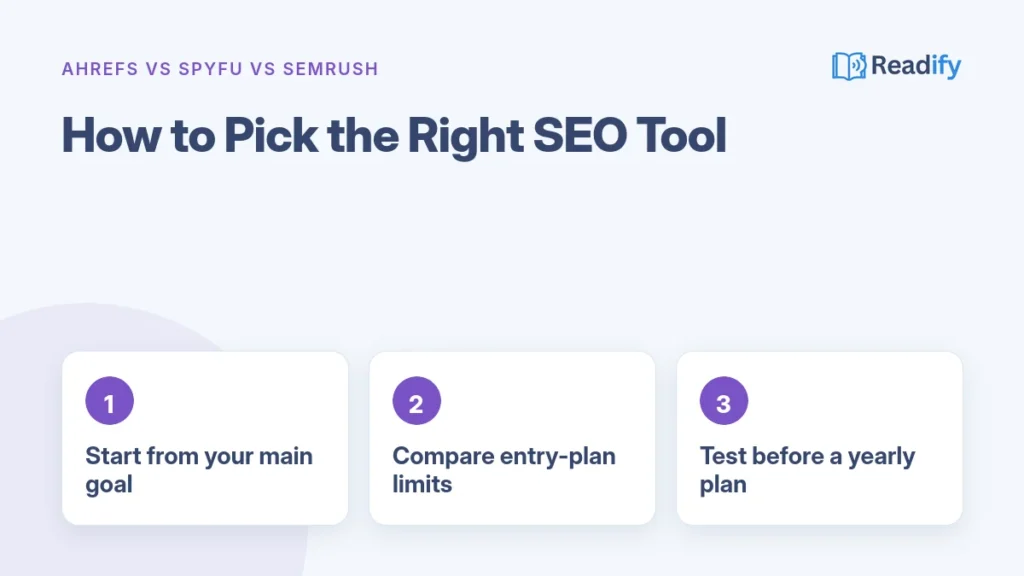
In the end, the Ahrefs vs SpyFu vs Semrush choice depends on your main goal: backlinks and content research, competitor PPC data on a small budget, or one all-in-one marketing suite. Most tools offer a trial or a free version, so test the one that fits your workflow before you commit.
In the end, the Ahrefs vs SpyFu vs Semrush choice depends on your budget and workflow: test the free trials or entry plans and keep the tool your team actually uses every week.
For agencies and teams needing comprehensive solutions, Semrush stands out with its wide range of features, including content and PPC management. Ultimately, businesses should choose based on their most pressing needs, whether that’s improving backlinks, understanding competitors, or managing multiple marketing channels.
The best approach is to test real projects and compare meaningful reports. This will help you find the platform that best fits your team’s workflow and budget.

One Comment
Comments are closed.