
How to Improve Brand Visibility in AI Search Engines: 8 Proven Steps
Want to know how to improve brand visibility in AI search engines like ChatGPT, Perplexity, Gemini and Google AI Overviews? This guide gives you 8 proven steps, from technical access to reviews, plus a simple way to measure your progress. It is part of our digital marketing guides.
Could a recommendation from a conversational tool bring more value than a familiar results page? AI search visibility measures how often these systems mention, cite, or recommend a company. Unlike a standard results list, an answer may draw from several sources and feature only a few names. That shift makes clear content, credible data, and trusted signals matter.
Adobe reported that retail traffic referred by these systems converted 38% worse than regular traffic during March 2025. By March 2026, it converted 42% better—a swing of 80 percentage points in one year. Those visitors spent 48% longer on a site and viewed 13% more pages.
Semrush research found that these visitors convert at 4.4 times the rate of traditional organic visitors. This is a pipeline opportunity, not just a metric to watch.
This guide covers crawl access, answer-first content, structured data, trusted third-party sources, fresh facts, and measurement across platforms. It also shows practical SEO steps that help companies earn citations, credibility, and trust.
Understand Brand Visibility in AI Search
AI brand visibility means a company gets named, cited, or recommended within a generated answer. Traditional search displays ranked links, while these tools select a shorter list of sources. Google Overviews also present a summary, so a citation can matter even when a page does not lead the results.
Before you learn how to improve brand visibility in AI search engines, check how they pick sources. Google explains in its guide to AI features and your website that pages must be indexed and eligible for a snippet to appear as supporting links in AI Overviews and AI Mode. There are no special requirements beyond the usual SEO best practices.
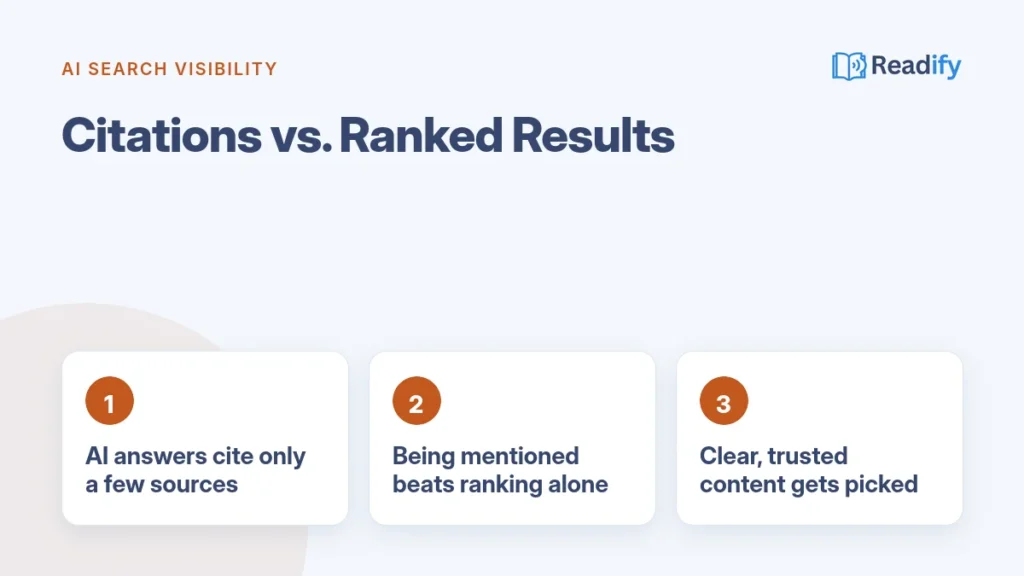
Citations versus ranked results
A high rank is not the only useful signal. Kevin Indig found that about 44% of large language model citations come from the first 30% of an article. Semrush found that ChatGPT cites pages at position 21 or lower almost 90% of the time. Clear, useful content can earn attention beyond top positions.
The business value of AI referrals
G2 surveyed 1,076 decision-makers. In March 2026, 51% of B2B buyers began research with a chatbot more often than Google, up from 29% in April 2025.
- 71% used chatbots during research.
- 69% switched vendors after a recommendation.
- 33% bought from a vendor they had not known.
These figures show why visibility matters: recommendations can shape choices and bring new people to a company. SEO teams should track citations and referral visits, not rankings alone.
How AI Engines Choose Brands to Surface and Cite
Generated answers favor entities they can identify and verify. Clear expertise, relevant content, and reliable sources help systems connect a company with useful topics. Five signals guide that choice:
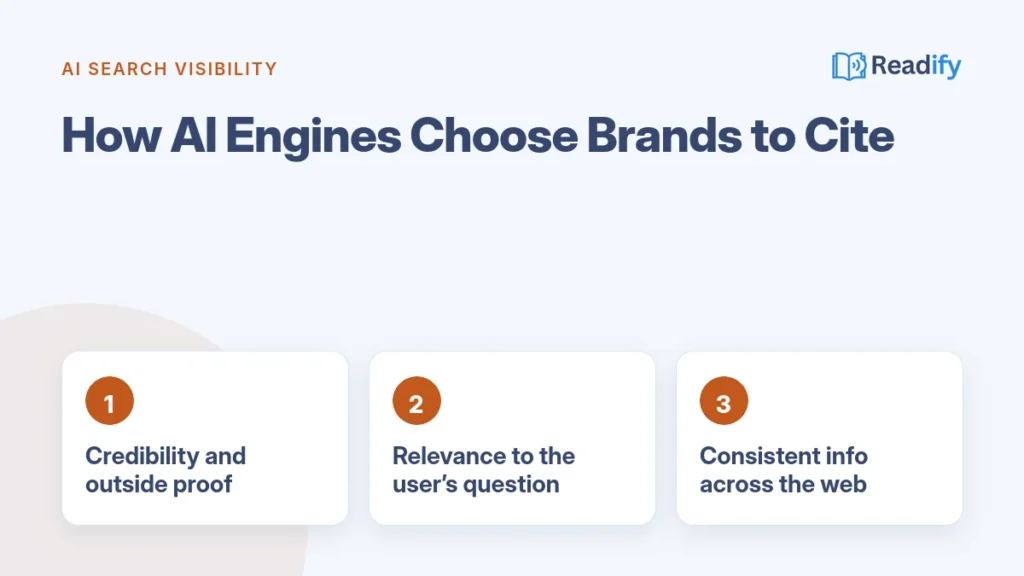
Credibility, relevance, and outside proof
- Entity recognition across trusted sources
- Third-party validation from respected sites
- Consistent company details across platforms
- Relevant content that answers buyer needs
- Credibility supported by clear evidence
Consistent names, services, and facts across company pages and reputable sources build trust. Conflicting details can weaken credibility. Relevant external links and schema, including structured data, support entity recognition, but they do not replace independent proof. G2 reports that 85% of B2B buyers think more highly of a vendor cited by AI. A credible citation can shape a buyer’s first impression and shortlist.
Why citations vary across platforms
ChatGPT, Perplexity, Gemini, and Google AI Overviews can cite different companies. Each product draws from distinct sources and uses different citation patterns. A competitor may appear on one platform yet not another. Track brand mentions across search tools, then check whether each citation reflects current data and expertise. Strong brand visibility depends on clarity, consistency, and credible evidence—not one ranking alone.
How to Improve Brand Visibility in AI Search Engines: Make Your Site Crawlable
Crawlers need a clear path before they can assess a page. Start with robots.txt and server or CDN rules. Confirm Googlebot and OAI-SearchBot can reach pages meant for citations. A blocked page cannot earn a mention, even when its content and schema offer strong signals.
Review access and indexing settings
Check priority pages for a 200 HTTP status code and remove accidental noindex directives. Keep the XML sitemap current, then submit it through Google Search Console. These checks support generative engine optimization and help confirm that a brand appears on the web where buyers can find it.
Remove barriers that hide key pages
- Fix redirect chains and broken internal links that waste crawl budget.
- Make each page’s main content available in raw HTML, not only through client-side JavaScript.
- Test whether Googlebot and OAI-SearchBot can render essential page content.
- Review links and site structure so crawlers can reach important pages.
Pages crawlers cannot reach or render are not eligible for citations, regardless of their quality or structured data. A sound technical foundation helps search engines process pages and gives future content a fair chance to support brand visibility.
Write Answer-First Content That AI Can Cite
Lead each section with a direct answer to its heading. Place the clearest response within the first 40–60 words, then add context, examples, or limits. This format helps readers and answer systems find useful details fast.
Lead with Direct Answers for Buyer Questions
Question-led headings connect a buyer’s question with the right response. Kevin Indig found that about 44% of LLM citations come from the first 30% of an article. Put key facts early, and give each passage enough context to stand on its own.
Use Clear Headings and Extractable Formats
Short paragraphs keep one idea clear. Lists, tables, and steps also make details easier to scan and quote. Use plain sentences that still make sense outside their original paragraph.
- Group related answers under descriptive headings.
- Use lists for features, steps, or comparisons.
- Keep figures and claims close to their sources.
Semrush found ChatGPT cites pages at position 21 or lower in traditional search almost 90% of the time. Clear content can earn citations beyond top results and support brand visibility.
Use Structured Data to Clarify Your Brand
Structured data gives AI systems machine-readable facts about a business, its people, and its content. Clear details reduce guesswork and help search tools connect names, roles, and services with reliable sources.
Connect your organization and people with schema and sameAs links
Add Organization schema for company details and Person schema for key leaders. Use the sameAs property to connect official profiles, such as LinkedIn, Crunchbase, and Wikidata. Accurate links help AI systems recognize the brand and connect it with its people, expertise, and offerings. This can support trust and help the brand appear with accurate mentions.
- Use Article or BlogPosting schema for editorial content.
- Choose FAQPage schema for pages with questions and answers.
- Keep names and details consistent across trusted sites.
Validate structured data on key pages
Test priority pages with Google’s Rich Results Test. Fix errors before expanding the setup across your site. Strong validation helps ensure each data signal matches the page’s purpose and content. These steps can support brand visibility, while clear structure helps people and search tools interpret key details. Review the markup after major page updates, too.
Build Topic Clusters Around Buyer Questions
A buyer’s broad question often contains several smaller needs. Someone choosing a CRM may also need details about pricing, setup, and support. AI query fan-out describes this process: a system breaks one query into narrower questions, then combines facts from multiple sources for an answer.
Map Related Questions Into Useful Supporting Content
A single page may not cover every topic a buyer or AI system needs. Map each question around a main subject, then plan useful content for each subtopic. For example, a pillar page about CRM tools can connect clearly with focused pages on setup, costs, and integrations.
- List buyer questions and related follow-up questions.
- Check search results, review sites, and competitor topics for gaps.
- Use Qforia from iPullRank, a free tool, to find fan-out queries. It requires a Gemini API key, which may involve small costs.
- Link each supporting page with clear, relevant links.
Useful linked content shows topical depth and gives readers a clear path to details. It can also earn brand mentions across search engines. For marketing teams, this connected structure can improve brand visibility over time, while helping buyers find direct answers rather than scattered facts.
Earn Third-Party Validation Through Digital PR
Third-party validation gives answer systems outside proof of a company’s expertise. When credible sources describe the same work, those references help AI tools verify claims across the web rather than rely only on a company’s statements. This evidence can build trust and improve brand visibility.
Offer original findings and expert insight
Give journalists useful material they can cite. Share original research, surveys, benchmarks, or datasets, with clear methods and useful data. Expert commentary adds context and helps publications connect your work with real buyer needs. These assets can earn brand mentions and a citation from trusted sources.
Choose relevant coverage over link volume
Prioritize contextual coverage from industry publications, trusted news outlets, and authoritative blogs. A few relevant links often carry stronger signals than many generic directory links. Subject fit supports credibility and helps search tools understand your expertise. This work forms a useful part of generative engine optimization and can improve brand visibility.
- Pitch findings that offer original value.
- Share expert views with relevant reporters.
- Answer questions on Reddit and Quora with useful, honest content.
- Earn links from sources your audience already trusts.
Genuine community participation can build recognition beyond your own site. Focus on helpful contributions, not promotion. Over time, relevant coverage and useful content create a stronger record for brands across the web.
Grow Review Velocity and Community Trust
A steady flow of candid customer feedback gives recommendations a stronger footing. Recent reviews help people judge whether a company still meets their needs.
Ask satisfied customers for honest, recent reviews
Build a regular request process rather than relying on one burst of feedback. Ask satisfied customers for honest accounts, and never pressure them for praise. Fresh, steady feedback can give AI systems useful signals about service quality and customer experience.
- Choose relevant sites, such as Google Reviews, Yelp, G2, Capterra, TrustRadius, Amazon, Facebook, or TripAdvisor.
- Keep requests consistent, so new experiences appear over time.
- Remember that third-party review content may inform generated answers.
Participate where buyers and AI systems find recommendations
Offer useful replies on Reddit, YouTube, TikTok, LinkedIn, and X. Clear facts help buyers assess expertise; sales pitches rarely build trust. These channels can shape mentions alongside review pages.
Authentic feedback and helpful participation create outside validation. Over time, this third-party validation gives people and AI systems evidence they can assess. Marketing teams can use those insights to address customer concerns. Together, these efforts support brand visibility; that visibility rests on useful content and honest experiences from customers and communities.
Keep Brand Information and Content Current
Outdated details can confuse buyers and weaken confidence. Treat accuracy as ongoing work: a clear identity and fresh information help people assess a company and support future citations.
Maintain consistent details across the web
Check the company name, address, phone number, and service descriptions across the official site, social profiles, directories, and third-party listings. Keep schema aligned with visible facts. This consistency gives buyers a coherent experience and helps trusted mentions point to the right company.
Refresh key pages on a regular schedule
Set a quarterly review for priority pages. Update statistics, examples, and insights when the topic changes. The large majority of AI citations reportedly come from content published or refreshed within the past two years, so current details matter.
- Show a visible “Last updated” date after each review.
- Replace old data with a reliable, current source.
- Check links, claims, and examples for accuracy.
- Flag pages that need another review.
Fresh, useful pages support trust and may earn future mentions across search platforms. Make each refresh part of the regular SEO workflow, not a one-time task. This steady care supports accurate answers and lasting brand visibility.
How to Improve Brand Visibility in AI Search Engines Over Time: Measure and Prioritize
Measurement turns activity into a clear plan. Track the signals that show whether people encounter, trust, and visit your company through generated answers.
Track useful measures
Review AI mentions, cited pages, share of voice, source opportunities, referral sessions, and entity accuracy. Together, these measures show where your brand appears, which sources support it, and whether platforms describe it correctly.
- Compare referral sessions with cited pages and citation trends.
- Watch for rising share of voice; it may lead changes in referred visits by 30–60 days.
- Log useful sources that could support future content or outreach.
Test buyer prompts on a regular schedule
Use realistic buyer questions across ChatGPT, Perplexity, Gemini, and Google Overviews. Record which company appears, which pages earn citations, and how each answer describes the company. Repeat the same prompts monthly; check weekly during active campaigns so shifts stand out.
Keep these measures as part of a wider marketing plan. Semrush projects that visitors from AI search may outnumber traditional organic visitors for digital marketing topics by early 2028. Consistent tracking gives teams time to act on results and focus optimization where it matters most.
Keep reading
- Ahrefs vs SpyFu vs Semrush: which SEO tool to track your visibility
- Hostinger vs Namecheap: fast hosting helps crawlers access your site
- What is AI arbitrage?
Want to go further?
Download practical ebooks and audiobooks on productivity, online business and digital marketing in the Readify shop, or start with our free ebook.
Conclusion
Strong AI search answers start with pages crawlers can reach and useful facts they can lift with ease. Clear, direct content gives each page a better chance at a citation. Structured data, consistent company details, and trusted outside references help systems confirm a company’s identity and trustworthiness.
Learning how to improve brand visibility in AI search engines is an ongoing process: start with the technical basics, publish answer-first content, then build trust step by step.
Fresh pages and honest reviews keep buyer-facing facts current across the web. Track company mentions, cited pages, referral sessions, and results from recurring prompts. Use gaps to set the next priority, then check whether changes earn stronger coverage.
Lasting brand visibility comes from connected work: sound technical access, useful content, authority, and steady measurement. Treat each part as an ongoing practice, not a one-time task.
2 Comments
Comments are closed.